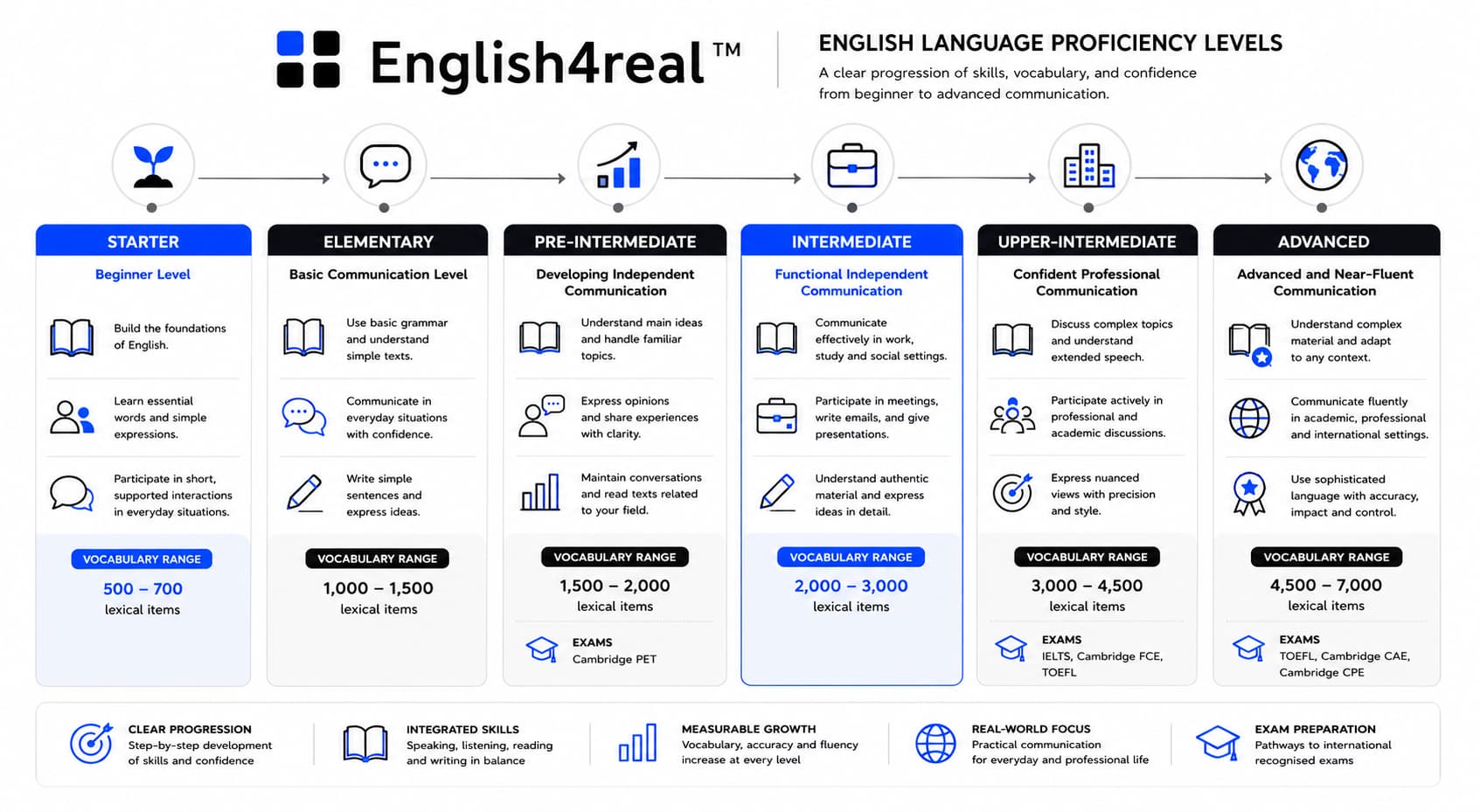
Below is a basic description of each language level and the communicative abilities typically developed upon successful completion of the course. Each level is characterised by a particular range of linguistic knowledge and communicative competence, including vocabulary, grammar, pronunciation, reading, listening, speaking, and writing skills.
Starter - Beginner Level
This programme is designed for learners beginning English from zero or near-zero level. It is intended for students with little or no prior knowledge of English, including limited vocabulary and minimal experience in reading, pronunciation, listening, or communication.
The course includes:
- introductory phonetics and pronunciation work;
- reading rules and sound recognition;
- essential grammar foundations;
- basic listening practice;
- communication tasks based on everyday situations.
Topics typically include:
- introductions;
- family and personal information;
- food and daily routines;
- work and free time;
- shopping;
- places and directions;
- basic social interaction.
Expected vocabulary range: Approximately 500 to 700 lexical items.
By the end of the level, students are generally able to:
- understand and use simple everyday expressions;
- introduce themselves and provide basic personal information;
- ask and answer simple questions;
- participate in short and predictable interactions with support.
Elementary - Basic Communication Level
This programme is designed for learners with limited but existing knowledge of English. Students at this level typically possess fragmented grammatical knowledge, limited conversational experience, and a restricted active vocabulary.
The course includes:
- development of pronunciation and listening comprehension;
- systematic study of basic grammatical structures and core tenses;
- guided speaking practice on everyday topics;
- controlled writing tasks;
- intensive vocabulary expansion.
By the end of the level, students are generally able to:
- read and understand short uncomplicated texts;
- communicate in familiar everyday situations;
- construct simple connected sentences;
- describe people, routines, preferences, and experiences;
- maintain basic social interaction in predictable contexts.
Expected vocabulary range: Approximately 1000 to 1500 lexical items.
Pre-Intermediate - Developing Independent Communication
This programme is intended for learners who demonstrate confident Elementary-level knowledge but possess limited practical experience using English in real communicative situations.
The course focuses on:
- expansion of grammatical and lexical range;
- development of listening comprehension;
- increased fluency and communicative confidence;
- longer spoken responses and narrative structure;
- reading and discussion of adapted authentic materials.
By the end of the level, students are generally able to:
- function adequately in familiar social and professional situations;
- understand the main ideas of clearly articulated speech;
- express opinions and describe experiences with reasonable clarity;
- maintain conversations at a natural pace in familiar contexts;
- understand the general meaning of texts related to their professional field.
Expected vocabulary range: Approximately 1500 to 2000 lexical items.
International examination preparation: Students at this level may begin preparation for the Cambridge PET examination.
Intermediate - Functional Independent Communication
This course is designed for learners who possess solid Pre-Intermediate knowledge and some practical experience using English for communication, work, or study. Students at this level are encouraged to engage actively with authentic English-language materials, including articles, podcasts, presentations, and video content.
The course focuses on:
- improving fluency and communicative flexibility;
- refining grammatical accuracy;
- expanding active vocabulary;
- developing discussion and presentation skills;
- strengthening reading, listening, and writing competence.
By the end of the level, students are generally able to:
- communicate successfully in a wide range of standard situations;
- participate in professional discussions and meetings;
- write emails and professional correspondence;
- give presentations on familiar topics;
- understand the main content of authentic spoken and written materials.
Expected vocabulary range: Approximately 2000 to 3000 lexical items.
Upper-Intermediate - Confident Professional Communication
This programme is intended for learners with substantial experience using English and confident command of Intermediate-level language structures.
The course includes:
- advanced grammar and discourse development;
- refinement of spoken precision and stylistic flexibility;
- expansion of topic-based and professional vocabulary;
- discussion of complex social, academic, and professional themes;
- analysis of authentic materials.
By the end of the level, students are generally able to:
- communicate confidently in most professional and social situations;
- participate actively in formal and informal discussions;
- express nuanced opinions with clarity and precision;
- understand complex texts and extended speech with limited support;
- function effectively in many English-speaking professional environments.
Expected vocabulary range: Approximately 3000 to 4500 lexical items.
International examination preparation: Students at this level may prepare for examinations such as IELTS, Cambridge First (FCE), and TOEFL.
Advanced - Advanced and Near-Fluent Communication
This programme is designed for learners with extensive experience using English in academic, professional, or international contexts.
The course focuses on:
- advanced communicative precision;
- stylistic flexibility and rhetorical control;
- sophisticated vocabulary development;
- analysis and production of complex spoken and written discourse;
- communication in nuanced, abstract, or high-pressure situations.
By the end of the level, students are generally able to:
- communicate fluently and effectively across a broad range of contexts;
- adapt language appropriately to formal, academic, and informal situations;
- participate confidently in complex discussions and negotiations;
- understand demanding authentic materials with a high degree of accuracy;
- study or work effectively in an English-speaking environment.
While occasional inaccuracies may still occur, communication is typically natural, precise, and professionally effective.
Expected vocabulary range: Approximately 4500 to 7000 lexical items.
International examination preparation: Students at this level may prepare for examinations such as TOEFL, Cambridge Advanced (CAE), and Cambridge Proficiency (CPE).