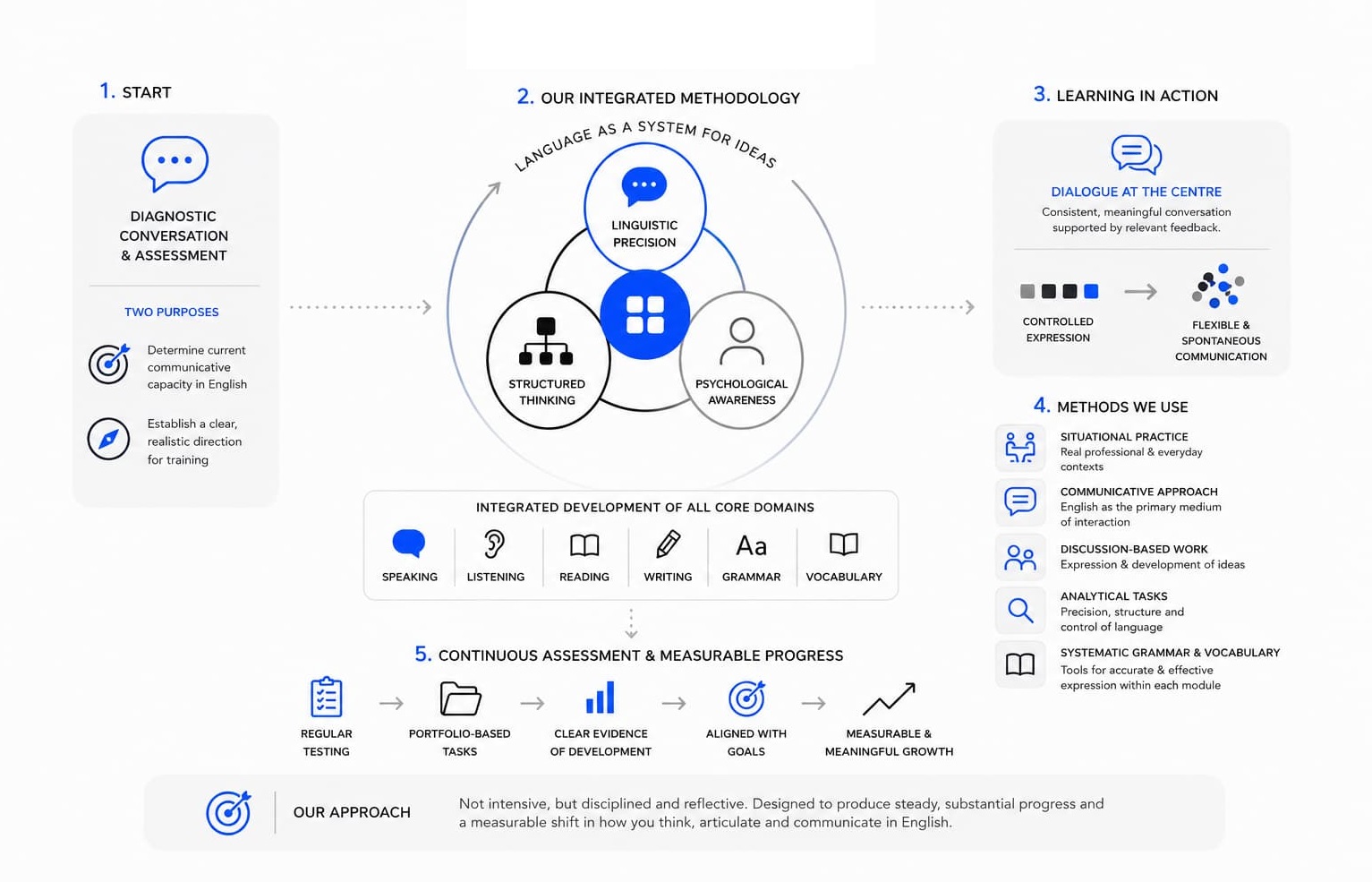
The learning process at English4real™ is structured and grounded in real-life communicative purposes. Each programme is adapted to the learner’s goals, current level, professional context, and expectations. For this reason, every study begins with a diagnostic conversation and assessment. This initial stage has two purposes: to determine the learner’s current communicative capacity in English, and to establish a clear, realistic direction for training.
The methodology itself seeks to integrate linguistic precision, structured thinking, and psychological awareness. Language is not treated as a set of isolated elements, but as a system through which ideas are formed, organised, and expressed. As a result, all core domains, including speaking, listening, reading, writing, grammar, and vocabulary, are developed and enhanced in an integrated and purposeful manner.
At the centre of the process is dialogue. Learning develops through consistent, meaningful conversation, supported by relevant and timely feedback. This allows the learner to move from controlled expression toward more flexible and spontaneous communication, while maintaining clarity and coherence of thought.
A range of methods is applied within this framework. Situational practice is used to model real professional and everyday contexts, including meetings, discussions, and presentations. The communicative approach ensures that English is used as the primary medium of interaction, supporting adaptation to real-life language use. Discussion-based work encourages the expression and development of ideas, while analytical tasks strengthen precision, structure, and control of language.
Grammar and vocabulary are studied systematically, not as separate domains, but as tools for accurate and effective expression within the key objectives of each module. An essential component of the process is continuous assessment. Progress is monitored through regular testing and portfolio-based tasks, providing both the learner and the instructor with clear evidence of development and growth. This ensures that the approach remains aligned with the learner’s goals and that progress is both measurable and meaningful.
Overall, the methodology is not intensive, but rather disciplined and reflective. It is designed to produce steady, substantial progress and a measurable shift in how the learner thinks, articulates, and communicates in English.