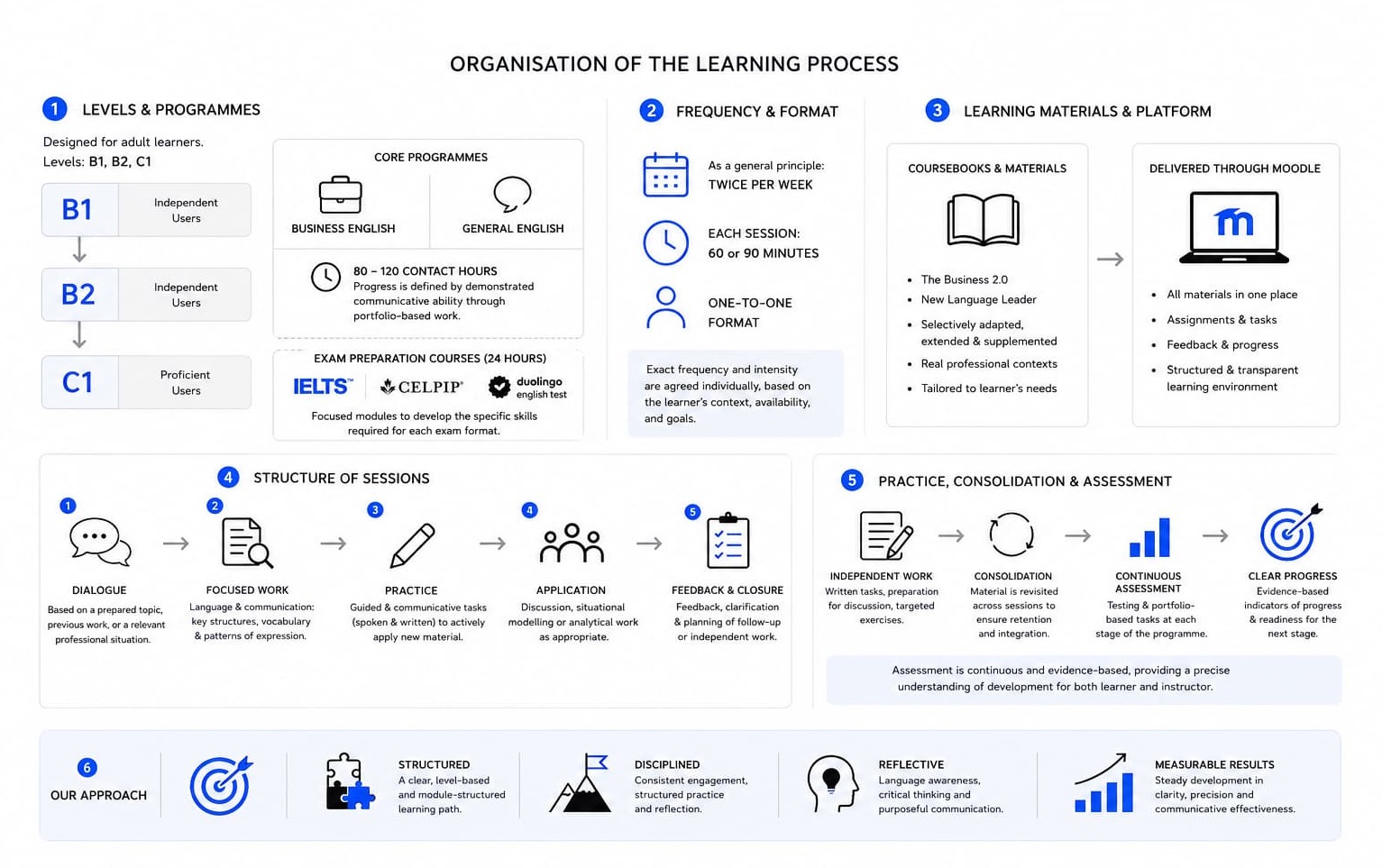
The learning process at English4real™ is level-based, module-structured, and aligned with real-life communicative needs. The programme is designed for adult learners working within the range of levels B1, B2 and C1.
Programme Structure and Duration
The core programmes are Business English and General English courses. Each level is organised as a structured course of approximately 80 to 120 contact hours. It is important to note that the progress is defined by time or number of classes attended, but by the demonstrated proven communicative ability through portfolio-based work.
In addition to the core programme, English4real™ offers courses to prepare learners for international examinations, including IELTS, CELPIP, and the Duolingo English Test. These courses are structured as focused modules of approximately 24 hours, designed to develop the specific communicative, analytical, and strategic skills required for each exam format.
The design and organisation of the courses are formed with an understanding that language development at each level is not a short-term process. It is rather a consistent engagement, structured practice, and sufficient time spent to consolidate and strengthen the newly acquired language skills. The key objective, whether it is a core program or an exam preparation COURSE, is not temporary performance, but stable, transferable communication.
Frequency and Format
As a general principle, sessions are conducted twice per week, with each session lasting 60 OR 90 minutes. This format allows for sufficient depth, continuity, and reflection between sessions. However, the exact frequency and intensity are agreed individually, based on the learner’s context, availability, and goals.
All work is conducted in a one-to-one format, ensuring precise adaptation to the learner’s professional environment and communicative needs.
Learning Materials and Platform
The core materials are based on established coursebooks, including The Business 2.0 and New Language Leader. These are not used in a standardised manner, but are selectively adapted, extended, and supplemented with additional materials. Content is continuously refined to reflect real professional contexts and the specific needs of each learner.
All materials, assignments, and feedback are organised and delivered through the Moodle learning platform. This ensures a structured and transparent learning environment, where progress, tasks, and feedback are clearly documented and accessible.
Structure of Sessions
Each session follows a coherent internal structure, while remaining flexible to the learner’s needs. Sessions typically begin with dialogue, often based on a prepared topic, previous work, or a relevant professional situation. This is followed by focused work on language and communication, including the introduction and analysis of key structures, vocabulary, and patterns of expression.
Practice is then carried out through guided and communicative tasks, both spoken and written, ensuring that new material is actively applied. Depending on the context, sessions may also include discussion, situational modelling, or analytical work.
Practice, Consolidation, and Assessment
Development is reinforced through structured independent work, including written tasks, preparation for discussion, and targeted exercises. Material is revisited across sessions to ensure retention and integration into active use.
Assessment is continuous and evidence-based. Each stage of the programme includes testing and portfolio-based tasks, providing clear indicators of progress. This allows both learner and instructor to maintain a precise understanding of development and to ensure readiness for progression to the next stage.
Overall, the process is structured, disciplined, and reflective, designed to support steady development and a measurable improvement in clarity, precision, and communicative effectiveness.